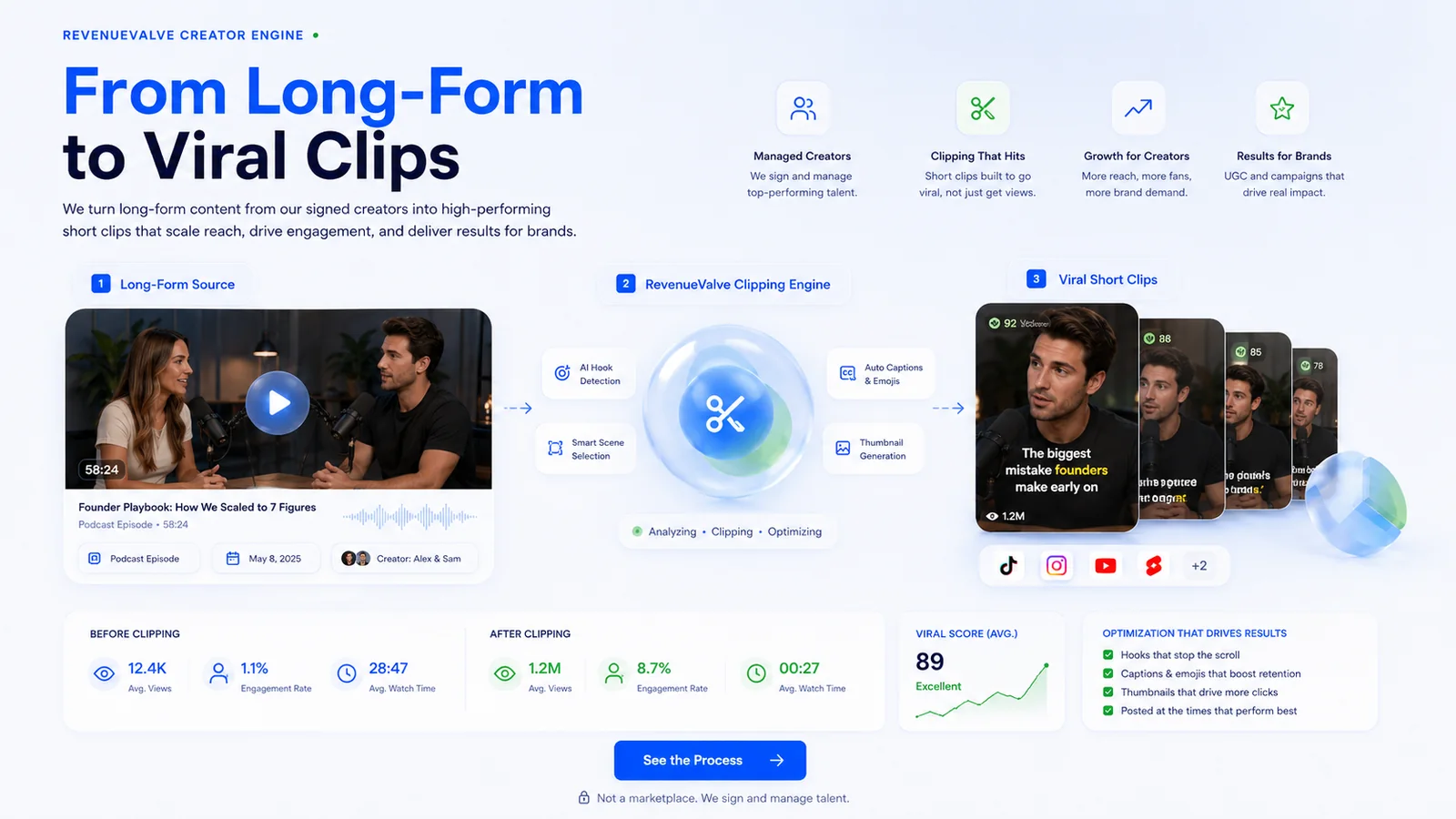
Clipping is not the act of cutting a long video into smaller files. A useful short-form workflow finds complete ideas, rebuilds the opening for a new viewer, removes context the clip does not need, and adapts the asset for the platform where it will live.
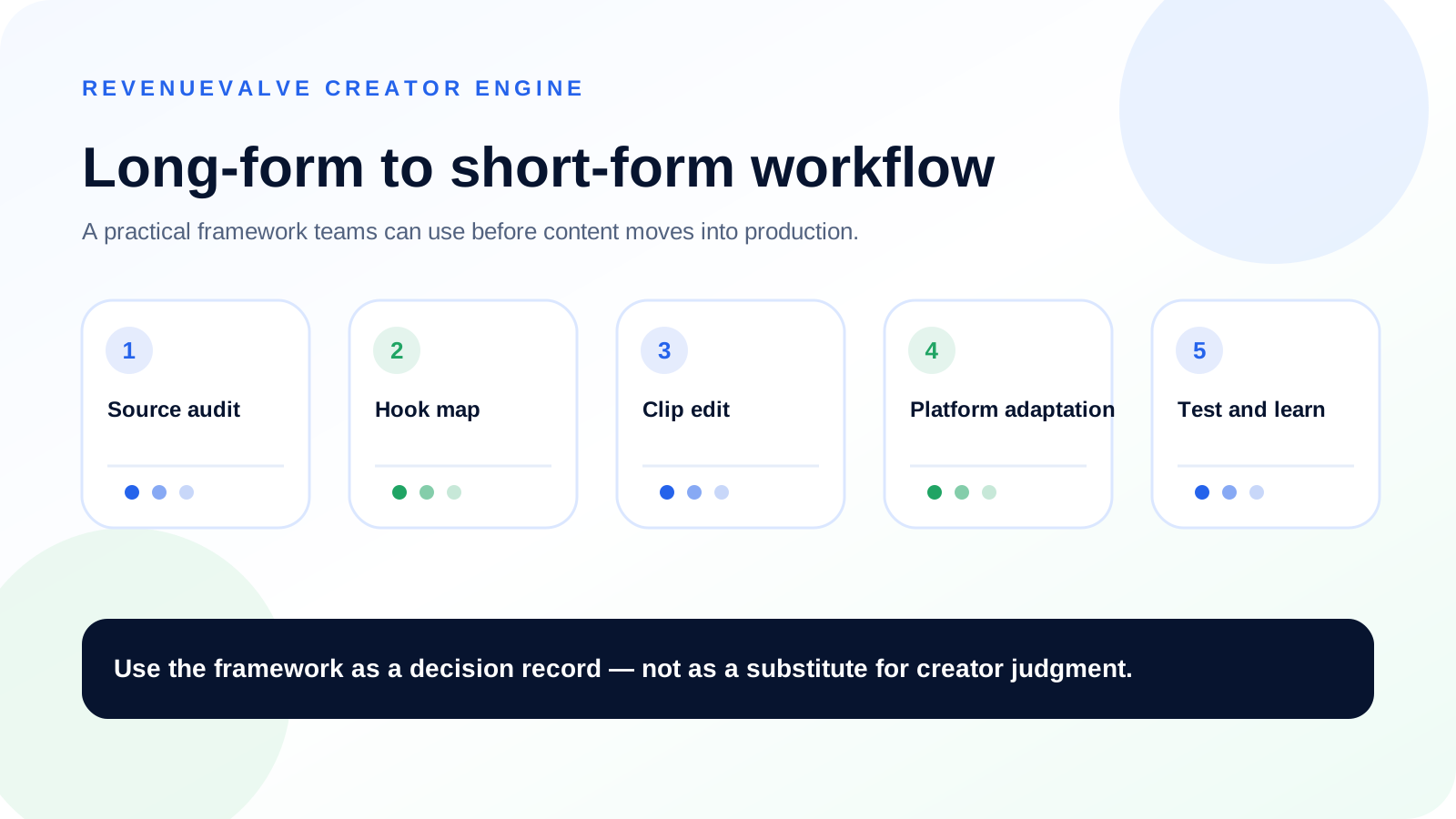
Start with a source audit
Not every long-form asset deserves to become twenty clips. Review the recording for useful moments: clear stories, specific advice, surprising data, strong opinions, demonstrations, mistakes, questions, and emotional changes. Mark complete ideas, not only dramatic sentences.
A source audit should record:
- Timestamp and topic
- Who is speaking
- Audience problem or question
- Core claim or lesson
- Proof, example, or story
- Possible opening lines
- Visual support available
- Claim, rights, or privacy concerns
Separate “interesting” from “useful for the target audience.” A founder story may be compelling but irrelevant to the buyer the campaign needs to reach.
Build a hook map before editing
The original speaker may take thirty seconds to reach the point because the long-form audience already understands the context. A short-form viewer usually does not. Write several openings around the same core idea.
Hook types
- Problem: “Most product demos lose the viewer before the product appears.”
- Contrarian observation: “The best-performing clip was not the most polished one.”
- Specific promise: “Here is the three-part brief that cut our revision time.”
- Story tension: “We almost canceled the campaign two days before launch.”
- Question: “What should a brand measure after a creator post?”
- Visual disruption: Show the result, mistake, or transformation before the explanation.
Do not write hooks that the clip cannot support. A dramatic promise followed by unrelated content may create a view, but it weakens trust and retention.
Use a short-form structure
A reliable structure is opening, context, value, proof, and next step. The sections can be very short, and some clips will not need all five, but the viewer should never wonder why the clip started.
- Opening: Establish the problem, result, or tension.
- Context: Give only the information required to understand the moment.
- Value: Deliver the idea, process, or explanation.
- Proof: Add the example, demonstration, data, or consequence.
- Next step: Invite the viewer to apply, comment, watch, download, or visit.
Remove greetings, housekeeping, repeated setup, filler words that slow comprehension, and references to earlier sections that are not included. Preserve natural breathing and emotion. An edit that removes every pause can feel anxious and artificial.
Edit for comprehension and retention
Captions
Captions should be readable, synchronized, and placed inside platform-safe areas. Highlighting key words can help, but excessive animation competes with the speaker. Correct names, product terms, and numbers manually.
Visual changes
Use b-roll, camera changes, screen recordings, graphics, and punch-ins when they clarify the idea. Do not add visual movement every second because a template demands it. The edit should direct attention to meaning.
Audio
Clean dialogue is more important than a loud music bed. Remove distracting noise, balance levels, and confirm music rights. TikTok recommends its Commercial Music Library for content promoting a brand, product, or service because general music licenses may not cover commercial use.
Length
Use the shortest length that completes the idea. Some clips need twelve seconds. A nuanced explanation may need sixty or ninety. Make length a result of structure, not a target imposed before the source is reviewed.
Adapt the clip for the platform
TikTok and Reels
Prioritize immediate context, mobile framing, readable text, and native pacing. Consider a caption that adds information instead of repeating the spoken line. Use the platform’s commercial-content tools when the clip promotes a brand.
YouTube Shorts
Use titles and channel context to connect the clip with longer content. YouTube Analytics can show reach, engagement, audience, and retention signals. A Short may create discovery even when it does not send immediate clicks.
LinkedIn and X
Professional and conversation-led platforms may benefit from more context in the accompanying post. A clip can introduce a clear argument, while the written caption provides details, sources, or a question that encourages discussion.
Do not publish the exact same caption, opening frame, and call to action everywhere. Preserve the idea while adapting the packaging.
Build a versioning system
Name files by source, topic, hook, length, ratio, version, and rights status. Store clean footage, captions, thumbnails, project files, and final exports. A content library should make it obvious which file is approved and where it can be used.
Example file name
founder-interview_pricing-objection_hook-b_30s_9x16_v03_paid-social-approved.mp4
Create a testing loop
Test one meaningful variable at a time when possible: opening line, first visual, proof order, length, CTA, or speaker. If every version changes completely, the team learns very little from the result.
Review early retention, average watch time, completion, saves, shares, comments, and action metrics. YouTube notes that engagement metrics are validated and may change as systems confirm legitimate activity, so avoid reacting to incomplete data immediately after posting.
A weekly clipping cycle
- Monday: audit new long-form sources and select ideas.
- Tuesday: write hook options and prepare rough cuts.
- Wednesday: review claims, clarity, and rights.
- Thursday: publish or launch controlled tests.
- Friday: document performance and audience questions.
- Next cycle: make follow-up clips using what viewers actually asked.
Quality-control checklist
- The clip communicates one complete idea.
- The opening is supported by the content.
- A new viewer has enough context.
- Captions are accurate and readable.
- Music and footage rights are confirmed.
- Commercial relationships are disclosed.
- Names, numbers, and product claims are correct.
- The CTA matches the viewer’s stage.
- The export fits the intended platform.
- The file is stored with approval and usage information.
A clipping engine becomes valuable when it turns existing expertise into a disciplined learning system. The team produces more testable ideas, identifies what earns attention, and uses that evidence to improve the next source recording instead of reducing creative judgment to a single score.