
The best creator brief does not tell a creator how to behave on camera. It gives the creator enough commercial, product, and audience context to make strong decisions. A weak brief produces delays, generic scripts, and endless revisions. A useful brief creates alignment before filming starts.
What a creator brief is supposed to accomplish
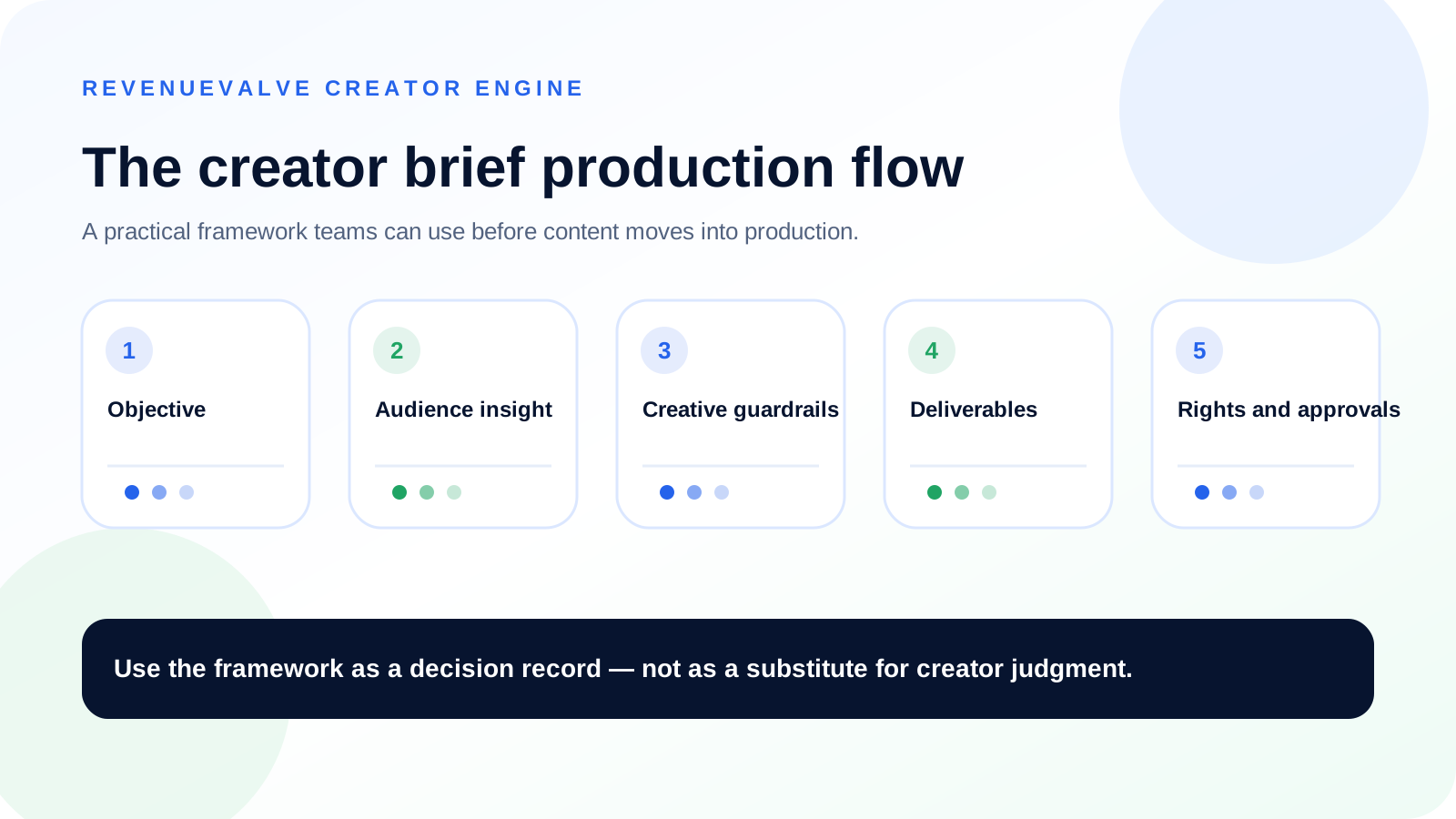
A brief should answer five questions before the creator opens a camera app: What are we trying to change? Who needs to care? What does the viewer need to understand? What must be delivered? What can and cannot be said or shown?
The brief is also a decision record. When a stakeholder later asks for a new claim, a different audience, a longer video, or another platform format, the team can identify whether the request fits the agreed scope. That prevents the creator from absorbing every late change as unpaid labor.
The essential sections of a high-performing creator brief
1. Campaign objective
Write the objective as a measurable communication task. “Create awareness” is too broad. “Help first-time buyers understand why the product fits a five-minute morning routine and encourage them to visit the product page” gives the creator something to build around.
Include one primary objective and, if needed, one secondary objective. Multiple priorities often create videos that mention everything and persuade no one.
2. Audience insight
Demographics are not enough. Describe the audience’s current situation, hesitation, language, and desired outcome. A useful audience note might read: “Busy professionals who already use basic skincare but avoid multi-step routines because they expect them to take too long.” That gives the creator a recognizable tension to dramatize.
3. Product truth and proof
Provide the facts the creator can rely on: ingredients, construction, process, pricing, availability, warranty, product origin, tested claims, and limitations. Separate mandatory facts from optional talking points. When claims require substantiation, give the creator approved wording and the evidence owner inside the company.
Beauty, wellness, nutrition, and health-related campaigns need particular care. The FTC advises marketers to support objective health claims with appropriate evidence. Creators should not be asked to improvise medical or performance claims from a product page.
4. The creative assignment
Define the content job instead of dictating every sentence. Examples include: demonstrate the product inside a normal routine, compare the old workflow with the new one, answer a common objection, document a first-use experience, or explain three reasons the product is useful.
Include desired emotional tone, pacing, environment, and proof moments. “Warm, practical, and confident” is more useful than “make it viral.”
5. Deliverables
- Number of concepts and final videos
- Aspect ratio and resolution
- Target length and acceptable range
- Hook variations and call-to-action variations
- Raw footage, clean footage, and edited exports
- Captioned and uncaptioned versions
- Thumbnail or cover requirements
- Still photographs or product detail shots
- File naming and delivery location
Specify whether one concept with three hooks counts as one deliverable or three. Small wording differences in the contract can create large expectation differences during production.
6. Required elements
Keep the mandatory list short. It may include the product shown clearly, an approved pronunciation, a specific demonstration, the disclosure, and one call to action. Every required line consumes time and reduces flexibility, so protect only what is commercially or legally necessary.
7. Prohibited elements
List claims, competitor references, unsafe demonstrations, visual conflicts, music restrictions, locations, or language the creator should avoid. Explain why a restriction exists when possible. Creators make better decisions when they understand the risk rather than receiving a mysterious list of “do not” instructions.
How to give guardrails without flattening the creator’s voice
Use a message hierarchy. The first tier contains facts that must be communicated. The second contains proof options. The third contains optional language, examples, and inspiration. This format makes the difference between a requirement and a suggestion obvious.
Provide reference content to explain pacing, framing, or product visibility, not to request a copy. The brief should identify what works in the reference. “Notice how the product appears in the first three seconds” is actionable. “Make this exact video” is not a creative strategy.
Usage rights, approvals, and disclosures
Usage rights
State the channels, term, territory, and media. Organic use on the brand’s social account is not the same as paid social advertising. Website use is not the same as retail display. Editing rights, raw footage, partnership ads, creator-handle advertising, and exclusivity should be addressed separately.
Copyright ownership and licensed usage are different concepts. A brand can receive a defined license without owning the creator’s entire work. If ownership is being transferred or the project is treated as work made for hire, the written agreement should be reviewed carefully.
Approval workflow
Identify who can approve, how feedback will be consolidated, and how many review rounds are included. A practical workflow is concept approval, first-cut review, final compliance review, and delivery. Give one person authority to send consolidated notes. Conflicting feedback from five stakeholders is a production problem, not a creator problem.
Disclosure
Paid relationships, free products, commissions, and other material connections generally require clear disclosure. The FTC advises that disclosures should be difficult to miss and understandable. Platforms also have their own tools: TikTok requires the content disclosure setting for commercial content, and YouTube asks creators to mark videos that contain paid promotion.
A complete creator brief example
Campaign
Product: A compact meal-prep container system.
Objective: Show busy professionals how the system makes weekday lunches easier to organize, then drive qualified visits to the product page.
Audience: Adults who want to pack lunch but stop because planning and cleanup feel inconvenient.
Assignment: Create a “Sunday setup to Wednesday lunch” story using your real kitchen and normal routine.
Mandatory proof: Show the container sizes, leak-resistant closure, refrigerator stacking, and one finished lunch.
Deliverables: Three concepts, two opening hooks per concept, 20–35 seconds, 9:16, captioned and clean exports, raw footage, three cover images.
CTA: “See the full set and sizes at the link.”
Usage: Six months of organic and paid social use in the United States; editing limited to cutdowns, captions, crops, and end cards.
Review: Concept approval within two business days; one consolidated revision round.
Restrictions: No food-safety guarantees, medical claims, competitor logos, or copyrighted music outside approved libraries.
Measurement belongs in the brief
Define how the content will be judged. For organic creator posts, the team may review reach, watch time, completion, saves, shares, comments, profile activity, and link performance. For paid media, track thumb-stop rate, hold rate, click-through rate, conversion rate, cost per acquisition, and creative fatigue. The brief should identify the data owner and reporting window.
A single asset may perform differently when posted by the creator, published by the brand, or used in an ad. Preserve the distribution context when comparing results.
Creator brief quality-control checklist
- Can a creator explain the objective in one sentence?
- Is the audience described by a real situation and hesitation?
- Are approved product facts separated from optional talking points?
- Are deliverables counted clearly?
- Are usage rights defined by channel, term, territory, and media?
- Are disclosure requirements included?
- Is there one approval owner?
- Are revision limits and deadlines realistic?
- Does the brief leave room for the creator’s language and judgment?
- Can the campaign team measure success with available data?
A well-written brief reduces unnecessary revisions, but its real purpose is better creative. It gives creators a clear target, gives brands a reliable process, and makes it easier to learn from the work after launch.
Sources and further reading
- FTC: Endorsement Guides—What People Are Asking
- FTC: Health Products Compliance Guidance
- TikTok: Commercial content disclosure
- YouTube: Paid product placements, sponsorships, and endorsements
- U.S. Copyright Office: What Is Copyright?
This guide is educational and does not replace legal review of a campaign agreement.